
Maker rebates are a psyop
So, you may have heard about the term "maker rebates". Maker rebates are just negative fees paid (received) by makers. In some places, it just means "reduced fees", but analogous arguments as below can be made for these situations.
A negative fee happens when you get paid by an exchange to trade. These are only offered on maker orders – orders that don't have a counterparty when submitted (rest in the orderbook before filling).
Incentives
Getting good liquidity on an exchange is crucial for its existence. Exchanges want to do everything to get those who provide it – "the makers".
So, a very standard way to do so is to incentivize the makers by paying them for creating orders that are filled. This is precisely what maker rebates are about. Of course, the exchange doesn't want to go bankrupt, so for every filled maker order they pay for, there is a taker order that must pay greater fees than what was paid to the maker.
But does it actually incentivize more market makers? The answer is no. I will show that it only does two things:
- for immature markets (large spread), it only rescales the price without affecting liquidity
- for mature markets (low spread), all taker orders are executed at worse effective prices than without maker rebates, which means that the liquidity actually worsens; the only thing that happens is that takers pay an additional tax to makers
This is very surprising for most. Why do exchanges do it then? Psyops.
"They have maker rebates, they care about getting deep liquidity for the users."
"I get paid for market making! Looks like I should go there and not to any other venue!" – even institutional players get caught up in this psyop.
Reasoning
Let's do a quick example. Let's say there's a maker who is willing to sell asset X for $100. There is a taker, they agree to the terms, so the taker pays $101: $1 to the exchange and $100 to the market maker.
In total:
- the maker got $100 for asset X,
- the taker paid $101 for asset X,
- the exchange got $1 in fees.
Now, let's consider a second situation. Let's say the maker who wants to get $100 for selling an asset. They expect to get $0.50 on the transaction as the maker rebate, so they're willing to sell the asset for $99.50. On the other side, there's a taker who is willing to pay $101 to buy the asset for $99.50 and pay $1.50 in exchange fees.
In total:
- the maker got $100 for asset X,
- the taker paid $101 for asset X,
- the exchange got $1 in fees.
As we can see, both situations are equivalent.
The exchange has the same effective fees, described by the difference between taker fees and the rebate. The market makers and users have the exact same positions created, so they should make decisions in an equivalent way no matter how the exchange described the terms to them.
One thing definitely changed: the price at which the trade reportedly happened. The exchange has the power to manipulate the reported trade price by regulating the maker rebates. This makes spreads seem lower: for taker sell orders, the price seems to be higher, while for taker buy orders – lower.
This is exactly what rebates change when effective spreads are larger than double the rebate: nothing, except for the reported price of the transaction. It gets reported closer to the mid-price, which makes the exchange seem like a more liquid one. The reality is, it just scaled both sides of the orderbook closer together in "official" numbers, while the effective trades remained the same.
Low spreads
In case market makers want to provide low spreads, the situation gets even worse than a lie about the liquidity.
When the spread is low enough, the makers, after accounting for the shift in effective trade price, would like to market make on a negative spread. Existing venues don't allow for orderbooks that intersect. Submitting a trade that would intersect with the other side of the orderbook would make the creator a taker, hence pay fees instead of receiving them in the form of rebates, so they resign from posting such orders and post at the best available price.
So, despite the maker may want to provide better prices, they can't. Liquidity that could be at a better price for takers must be added at a worse effective price.
In this situation, makers can't compete on price anymore. They are incentivized to quote buys and sells a single tick away, "locking in" the price at some level. As long as the price stays within the maker rebate rate, despite the fact that the actual effective price may be worse than what the asset "officially trades at", that strategy yields them profits. If the price diverges too much, they just make the price jump to the correct price.
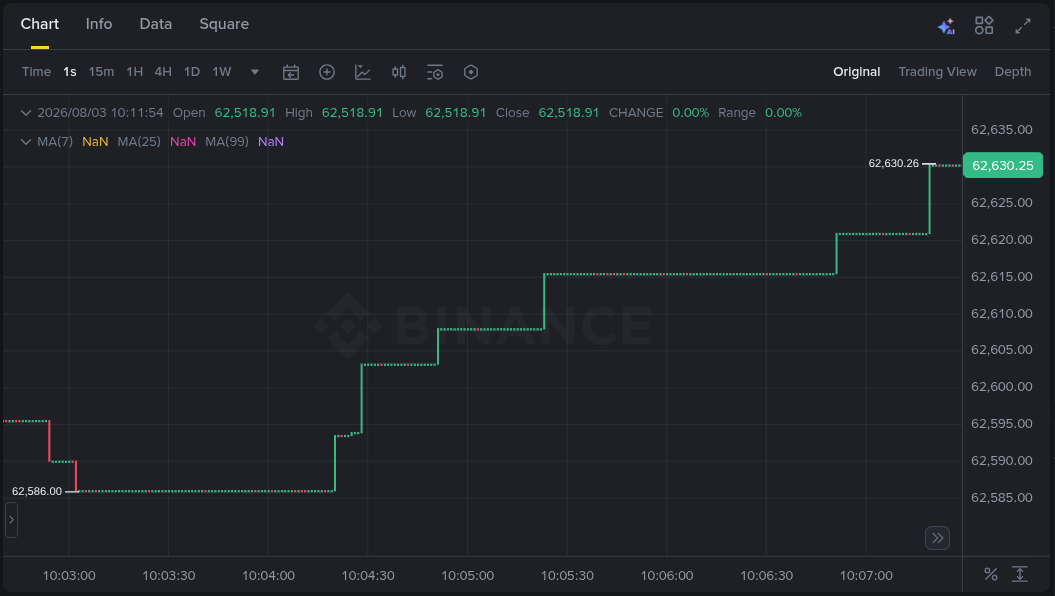
BTC/USDT price is often locked in for more than 60s, despite numerous trades per second.
The above is the reason you don't see "nice" price discovery on many popular assets, only trades at two prices a tick away for hundreds of trades, only for the price to jump in a single trade and stay in its new place for a while.
In this scenario, market makers start competing on who provides the quote at the locked-in price first (FIFO), because the first maker will get to take all the orderflow. Rebates create games that just aren't about getting the orderbook users (takers) the best price possible (i.e. best liquidity). These are pointless games, only propelling the exchange's liquidity psyop, because liquidity looks higher than it actually is, despite being worse.
From takers' perspective (who are the ones who care about resting liquidity), the only impact this has is creating a minimum spread. This is precisely the opposite of building good liquidity.
Worst-case scenario
The problem with locking in the price is that it can make the price much worse to trade at. Despite the true price got better for your trade as a taker, the exchange is incentivizing makers to lock in the price at the previous one (worse one). On top of that, you're forced to pay them even larger fees for this (by the size of the rebate).
In this situation, takers pay double the rebate for nothing.
Fee manipulation availability
In case both fees and rebates are considerable, the net fees may be low. The exchange may advertise this fact, either directly, or by saying that their execution, even after fees, is better than most other venues.
Exchanges don't have to inform retail users about rebate changes, unlike increasing fees. So, they can start by advertising great liquidity, but after retail migrates to them, decrease or remove market rebates. This will cause the effective fee rate to be very high, and retail users will not be informed, since their fee hasn't changed.
What an amazing way to hide fee schedule changes!
Popularization
I believe exchanges know exactly what they're doing. Straight-up malice to manipulate the apparent liquidity is an interpretation, but I don't think it's a proper way to think about it. If everybody is "tweaking the numbers" like this, as any exchange, you're forced to do the same or slowly disappear from the scene simply because the psyop works.
I'm not sure how the future of rebates looks like. Will we always continue to have this "mind worm" in the exchange infrastructure? Will the public realize that rebates aren't providing any value, only losing it? Will users discount exchanges accordingly?
I've made my first step by summarizing the knowledge in the post. Now you also know.
Summary
In case native spreads are high (higher than double the rebates), rebates have no impact on liquidity and only manipulate the effective price of the trade to be closer to the mid-price.
In case the spreads are low (lower or equal to double the rebates), rebates create minimum effective spreads, where makers can't compete on how good the price is.
In both cases, it's bad.
But people get excited. Market makers start fake-justifying making the markets. Users feel like the exchange cares about liquidity. The orderbook looks nice at a first glance, because the spread falsely seems to be practically zero!
The psyop doesn't seem to be limited to retail. Even institutional makers sometimes get caught up searching for ways to farm rebates. Regulators like the SEC consider "artificially narrow[ing] displayed spreads" a benefit for retail, probably by comparing to a situation with zero rebates and the same taker fees.
Having fee rebates is worse than zero maker rebates and taker fees decreased by the rebate.
Thanks to Jacek Czarnecki, Ella Papanek, and VNTGPRN for valuable feedback on this post.